
There’s no single best airless sprayer for cabinets because every buyer brings different habits and demands to the job. What really decides it’s how much paint you’ll push through in a year, whether you want a separate hose feeding from a bucket or a handheld cup, and how fine your finish needs to be. These machines don’t rank above each other; they just solve different problems. Some hold everything in your hand while others stand on the floor with a long hose reaching your work. If you’re doing a quick kitchen update, the Graco TrueCoat 360 Variable keeps things light and simple. If you need dedicated cabinet precision with a full kit ready out of the box, the PHALANX 3000PSI Airless splits that vote.
Table of Contents
5 Best Airless Sprayer for Cabinets: 7 Top Picks Reviewed


1. Graco 26D283 TrueCoat 360 Variable Speed Paint Sprayer

Best for: DIYers spraying a few cabinets without mixing or thinning paint first.
A cabinet job means tight spaces and a smooth final look. You don’t want heavy brush marks ruining flat panels. The variable speed control lets you slow down for detailed trim or speed up for wide door faces. That matters because rushing a slow-drying paint causes runs, while moving too slowly builds up thick drips. It’s built for projects up to two gallons, which covers a standard kitchen run.
It’s a handheld unit, so your arm holds the whole weight while you work. That makes it great for someone who paints once or twice a year. But it isn’t for someone spraying entire rooms back-to-back.
Good if:
- You only paint small batches like a single set of doors.
- You hate thinning paint before spraying.
- You want to control your speed manually.
Skip it if:
- You plan to spray more than two gallons at a time.
- You need a long hose to reach across a large workshop.
2. PHALANX 3000PSI Airless Paint Sprayer

Best for: Homeowners wanting a complete setup specifically tuned for detailed furniture renovation.
Cabinet doors demand even coverage without spitting or streaking. The all-metal spray gun here handles adjustable pressure, letting you dial down the force for delicate wood surfaces. A high-pressure machine usually risks blowing out too much material on small parts. Having that control means you won’t waste paint or ruin a sanded surface. It also comes as a ready-to-use kit with a 25-foot hose, multiple nozzles, and cleaning tools.
The listing notes it feeds directly from paint buckets using its long hose. That keeps the heavy motor off your hands while you focus on the spray pattern. It handles latex, oil-based paint, primer, and stain without thinning. However, it isn’t for someone who wants a tiny, one-handed tool for touching up a single drawer front. The hose and bucket setup takes up floor space, which crowds a very small room.
Good if:
- You want metal gun durability for repeated use.
- You need several nozzle sizes for different finishes.
- You prefer drawing paint straight from the bucket.
Skip it if:
- Your workspace has no room for a hose and bucket.
- You only ever touch up tiny spots rather than full doors.
3. Graco Magnum 257025 Project Painter Plus Paint Sprayer

Best for: People painting cabinets alongside larger household projects throughout the year.
Sometimes a cabinet refresh is just part of a bigger weekend plan. You might do the kitchen doors, then move to a fence or a bedroom wall. This model supports projects up to five gallons, doubling what smaller handhelds manage. Its flexible suction tube drops right into a one- or five-gallon bucket so you aren’t constantly refilling a small cup. The fully adjustable pressure control lets you spray unthinned paints or stains at any setting you choose.
It also supports up to 50 feet of paint hose to reach peaks or second stories. That length is fantastic for exterior house painting but requires careful management indoors. Dragging fifty feet of hose around a kitchen island can knock over masking tape or dust sheets. So, this isn’t for a buyer who only ever works inside a cramped bathroom or a small closet.
Good if:
- You tackle both indoor furniture and outdoor fences.
- You want to spray directly from large five-gallon buckets.
- You need a long hose to reach distant walls.
Skip it if:
- You strictly paint small items in tight indoor spaces.
- You don’t want to manage a long hose during detailed work.
4. InoKraft MaXpray M1 Airless Paint Sprayer

Best for: Beginners needing guidance while spraying large volumes of unthinned paint safely.
If you’ve never used an airless sprayer, the learning curve feels steep. This machine includes a laminated Quick Start Guide and video tutorials explaining priming, pressure adjustment, and technique. That support stops you from guessing how to set up the pump correctly. It pushes up to 0.31 GPM at 3000 PSI, handling projects up to ten gallons. For cabinets, the 360-degree swivel helps the gun move smoothly through inside corners and tight hinge areas.
Good if:
- You’re buying your very first airless sprayer.
- You need to flush the system quickly with a garden hose.
- You spray tight cabinet corners using the 360-degree swivel.
Skip it if:
- You already own hoses, tips, and extensions you prefer.
- You only paint small touch-ups under a gallon.
5. VEVOR Stand Airless Paint Sprayer

Best for: DIYers who want a stable floor-standing base for indoor and outdoor spraying.
Holding a sprayer steady is hard when the motor vibrates in your hand. A stand model sits on the floor, letting you focus entirely on guiding the gun. This one uses a 7/8HP 650W motor designed for higher efficiency, spraying faster than a roller or brush. The output pressure adjusts via a control valve knob to meet different spray needs. That adjustability helps prevent messy spills, which the listing claims it reduces by up to 55%.
You get a 25-foot hose, a 517 tip, and an 11.8-inch extension rod for reaching high or low spots. It handles water-based or oil-based paints like latex, chalk, stain, sealer, and varnish. Cleaning just requires running water or solvent through the sprayer until the paint clears out. It recommends up to 125 gallons of annual use. It isn’t for someone who needs to carry their sprayer up and down stairs constantly. Moving a stand unit between floors adds real effort to the job.
Good if:
- You want the motor resting on the floor, not your arm.
- You switch between latex, chalk, and oil-based coatings often.
- You need an extension rod for tall cabinet frames.
Skip it if:
- You frequently move the sprayer between different floors.
- You prefer a lightweight handheld unit for quick jobs.
6. Titan Tool 0524093 FlexSpray Paint Sprayer
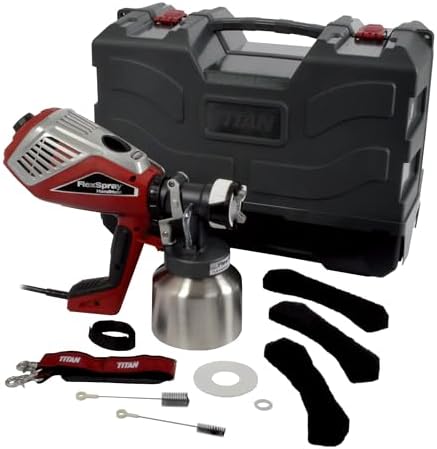
Best for: Woodworkers switching between heavy coatings and delicate cabinet lacquers easily.
Cabinets often need very fine finishes like lacquer or stain, not just thick wall paint. This sprayer uses Jetforce Technology to handle both heavy and light coatings. What makes it unique is the Quick Change front end system. For finishing cabinets, furniture, or trim, you attach the FineFinish front end. When you move to large surfaces like walls, you swap to the FlexFinish front end.
Precise controls make it easy to apply coatings on vertical, horizontal, or round shapes. It comes with a storage case and shoulder straps, keeping everything organized between uses. This dual-front-end design solves the biggest problem with spraying cabinets: getting a smooth finish without switching machines. However, it isn’t for someone who only ever sprays basic interior wall paint. If you never use fine lacquers or stains, the specialized front ends won’t see much action.
Good if:
- You spray fine lacquers and stains on cabinet doors.
- You want to change coatings quickly with a twist.
- You need a storage case to keep parts organized.
Skip it if:
- You only spray standard latex wall paint.
- You don’t need interchangeable finishing attachments.
7. Graco TrueCoat One Airless Paint Sprayer

Best for: First-time users wanting continuous operation without losing prime mid-project.
Nothing frustrates a beginner like a sprayer that stops spitting paint halfway through a door. This model features an always-on design that keeps the sprayer primed and ready continuously. You never lose prime mid-project, which delivers smooth, consistent coverage without stopping. The EverPrime technology ensures fast startup and consistent spray pressure so you get to work faster. It uses TrueAirless technology to spray unthinned paint, stain, and sealers directly from a standard container.
Adjustable speed control lets you dial in the flow for detailed trim or larger surfaces. It’s built for projects up to three gallons and includes a long hose that lets you leave the pump outside the room, along with a TC spray gun, a wide tip, and a PowerFlush adapter. The ergonomic design aims for comfortable use on cabinets, furniture, and garage doors.
Good if:
- You hate re-priming the pump after every pause.
- You want fast startup with consistent pressure.
- You need a power flush adapter for easier cleanup.
Skip it if:
- Your project exceeds three gallons regularly.
- You need industrial-level daily volume capacity.
Where These Overlap
Several of these sprayers share core traits that make the choice less obvious. The Graco TrueCoat 360 Variable and the Graco TrueCoat One both target small projects and spray unthinned paint. They overlap heavily, but the TrueCoat One adds EverPrime technology and a continuous-operation design to prevent losing prime. If you stop and start often, the TrueCoat One wins; if you just want manual speed control, the 360 Variable does the job.
Similarly, the PHALANX 3000PSI Airless and the InoKraft MaXpray M1 both deliver 3000 PSI and include hoses long enough to keep the pump stationed outside your workspace. The PHALANX focuses on its all-metal gun and cabinet-specific marketing, while the InoKraft leans into beginner guides and a garden-hose flush valve. If you need step-by-step instructions, pick the InoKraft. If you prioritize a metal gun for heavy use, the PHALANX separates itself. The rest genuinely differ in form factor or specialty.
Still Not Sure?
How many gallons will I actually spray?
Volume determines which sprayer fits here. If you’re doing one set of kitchen cabinets, you’ll likely use under three gallons total. Handheld models or small stand units fit that perfectly without wasting setup time. But if you plan to spray the cabinets, the walls, and the ceiling in one weekend, you need a machine rated for five to ten gallons. Check your project list before choosing. For small batches, stick with the Graco TrueCoat 360 Variable.
Do I need to thin my cabinet paint first?
Most modern airless sprayers push unthinned latex, acrylic, or oil-based paint straight from the container. Thinning paint alters the drying time and can ruin a smooth cabinet finish. Most of these machines specify they handle unthinned coatings, though you should always follow your specific paint manufacturer’s preparation guidance. Avoiding the thinning step saves time and keeps the finish consistent. If you want guaranteed unthinned performance with a metal gun, consider the PHALANX 3000PSI Airless.
Will I struggle to clean this afterward?
Cleaning an airless sprayer takes longer than washing a brush, and skipping it ruins the pump. Some models include special flush valves that connect to a garden hose, saving you from disassembling the whole system. Others just require running solvent or water through the line until it clears. If cleanup worries you most, prioritize a machine with a dedicated flush adapter or easy-wash design. The InoKraft MaXpray M1 makes this step significantly easier.
Choosing the Best Airless Sprayer for Cabinets comes down to your workspace and your patience for setup. If you want a lightweight tool for a quick kitchen refresh, the Graco TrueCoat 360 Variable keeps things simple. If you need a dedicated kit with a metal gun and precise pressure control for detailed work, the PHALANX 3000PSI Airless handles that role. Pick the one matching your project size, read the manual before plugging it in, and mask off your hinges carefully.
Frequently Asked Questions
Can I spray cabinet doors with unthinned latex paint?
Yes, all the sprayers here are designed to push unthinned latex, acrylic, and oil-based paints. Just ensure you use the correct tip size recommended by your paint manufacturer. The PHALANX 3000PSI Airless explicitly lists unthinned latex compatibility for furniture renovation.
What tip size works best for spraying cabinets?
Cabinet doors require a finer finish than exterior siding or rough fences. Smaller tip sizes produce narrower fan patterns and thinner coats, preventing runs on vertical surfaces. The VEVOR 650W Stand Airless includes a 517 tip, which may require lower pressure settings for fine furniture. Always check your paint can for the manufacturer’s suggested tip range.
How does a 25-foot hose help with indoor cabinets?
A 25-foot hose lets you leave the heavy pump outside the room while you spray inside. This keeps fumes and potential spills away from finished floors. Both the InoKraft MaXpray M1 and the Graco TrueCoat One include a 25-foot hose for this exact reason. You gain mobility around the cabinet frames without dragging a heavy machine behind you.
Why do some airless sprayers lose prime during use?
Losing prime happens when air enters the fluid line or the pump runs dry temporarily. It forces you to stop, bleed the air out, and restart the flow, which leaves dry spots on wet paint. Continuous-operation designs prevent this by keeping the system pressurized even when you release the trigger. The Graco TrueCoat One uses EverPrime technology specifically to maintain consistent pressure and avoid mid-project interruptions.
Conclusion
Pick the setup that matches how often you’ll actually use it, then clear out a spare room or garage to practice. You don’t need perfect conditions on your first try. Just lay down some cardboard, thin your paint slightly, and get comfortable before touching your kitchen doors.